


Dear Friends! I would like to invite You and your group to experience the magic of Barcelona and the Costa Brava at our upcoming competition Sea Sun Festival. This is a unique opportunity to experience the vibrant culture and traditions of Catalonia whil...

Innismara, meaning “island in the Sea” in Irish Gaelic, is an autonomous vocal chamber ensemble that fills a gap in the rich tapestry of choral music in Newfoundland and Labrador. Comprised of professionally trained musicians, Innismara is dedicated to th... onclick="$(this).getParent().getNext().style.display='';$(this).getParent().style.display='none';">moreone;">Innismara, meaning “island in the Sea” in Irish Gaelic, is an autonomous vocal chamber ensemble that fills a gap in the rich tapestry of choral music in Newfoundland and Labrador. Comprised of professionally trained musicians, Innismara is dedicated to the performance of the intimate and hidden treasures of the vocal ensemble repertoire. Innismara made its debut in the summer of 2010 at Muses and Minstrels: A Festival of Early Performing Arts held in conjunction with the Cupids 400 celebrations. In collaboration with the Hot Earth Ensemble, Innismara performed music from the late Renaissance and early Baroque, highlights of which were recorded for national broadcast on CBC Radio. The success of these performances led to an invitation to participate in a series of workshops and performances in the Labrador Inuit communities of Nunatsiavut in the spring of 2011. The entire exchange project was recorded by film-maker Nigel Markham and CBC radio producer Francesca Swann for a documentary film on the choral tra... onclick="$(this).getParent().getPrevious().style.display='';$(this).getParent().style.display='none';">less
What Is a Singing Retreat? A Guide for Beginners Imagine taking a deep breath of fresh Sea air, relaxing completely, singing your heart out, and enjoying delicious home-cooked meals — all while surrounded by the breathtaking beaut...

Music in Mocean is all about consciously encouraging individuals to come together and share and enjoy our love of music. You will be singing in a supportive environment where everyone is welcome regardless of experience or skill level. We typically beg... onclick="$(this).getParent().getNext().style.display='';$(this).getParent().style.display='none';">moreone;">Music in Mocean is all about consciously encouraging individuals to come together and share and enjoy our love of music. You will be singing in a supportive environment where everyone is welcome regardless of experience or skill level. We typically begin the class by Integrating body, mind and soul through stretches, breathing and movement so that we are totally relaxed and ready to sing and play ! We have the opportunity through the classes to hone our technical skills by learning about musical composition and vocal technique ! onclick="$(this).getParent().getPrevious().style.display='';$(this).getParent().style.display='none';">less
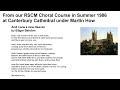
Anthem by Edgar Bainton And I saw a new heaven and a new earth: for the first heaven and the first earth were passed away; and there was no more Sea. And I John saw the holy city, new Jerusalem, coming down from God out of heaven, prepared as a ... onclick="$(this).getParent().getNext().style.display='';$(this).getParent().style.display='none';">moreone;">Anthem by Edgar Bainton And I saw a new heaven and a new earth: for the first heaven and the first earth were passed away; and there was no more Sea. And I John saw the holy city, new Jerusalem, coming down from God out of heaven, prepared as a bride adorned for her husband. And I heard a great voice out of Heaven, saying, Behold, the tabernacle of God is with men, and he will dwell with them, and they shall be his people, and God himself shall be with them, and be their God. And God shall wipe away all tears from their eyes; and there shall be no more death, neither sorrow, nor crying, neither shall there be any more pain: for the former things are passed away. (Revelation 21) Sung at Canterbury Cathedral during our Royal School of Church Music Summer Course in 1986, under Martin How. I (David W Solomons) was one of the altos. John Huntley - a fellow alto - recorded this performance. onclick="$(this).getParent().getPrevious().style.display='';$(this).getParent().style.display='none';">less
The first of three settings of text from the Odes of Solomon. The Odes of Solomon are believed to have been written around the year 100 A.D., and include strong parallels to the Dead Sea Scrolls. Scholars have debated whether the Odes should be consid... onclick="$(this).getParent().getNext().style.display='';$(this).getParent().style.display='none';">moreone;">The first of three settings of text from the Odes of Solomon. The Odes of Solomon are believed to have been written around the year 100 A.D., and include strong parallels to the Dead Sea Scrolls. Scholars have debated whether the Odes should be considered Jewish, Christian or Gnostic, and whether they were first written in Greek, Hebrew or Syriac. Early Christian writings refer to and quote from them. A Syriac manuscript containing the text of most of the Odes was discovered in 1909 by the English scholar J. Rendel Harris, and other partial texts in various languages have also been found. There are 42 Odes. Some fragments are still missing from Odes I and III, and no part of Ode II has yet been found. For these choral settings, I selected text from four of the Odes of Solomon which I found particularly compelling. The anonymous translation I have used comes from The Gnostic Society Library. onclick="$(this).getParent().getPrevious().style.display='';$(this).getParent().style.display='none';">less
I Never Saw Music: Davide Riva (1989 - *) Text: Emily Dickinson (1830 - 1886) Mixed choir (SATB) | Composed for "Bormio Young Vocal Ensemble" All parts performed, recorded and mixed by Diego Ceruti I never saw a Moor I never saw the Sea Yet... onclick="$(this).getParent().getNext().style.display='';$(this).getParent().style.display='none';">moreone;">I Never Saw Music: Davide Riva (1989 - *) Text: Emily Dickinson (1830 - 1886) Mixed choir (SATB) | Composed for "Bormio Young Vocal Ensemble" All parts performed, recorded and mixed by Diego Ceruti I never saw a Moor I never saw the Sea Yet know I how the Heather looks And what a Billow be. I never spoke with God Nor visited in Heaven Yet certain am I of the spot As if the Checks were given

We are an all female chamber choir from Southend-on-Sea (UK). The choir is available for weddings and other events and we singing a wide range of music from pop to choral, soul to swing. Contact us for more information via email at chamber@southendvox.com
The second of three settings of text from the Odes of Solomon. The Odes of Solomon are believed to have been written around the year 100 A.D., and include strong parallels to the Dead Sea Scrolls. Scholars have debated whether the Odes should be consi... onclick="$(this).getParent().getNext().style.display='';$(this).getParent().style.display='none';">moreone;">The second of three settings of text from the Odes of Solomon. The Odes of Solomon are believed to have been written around the year 100 A.D., and include strong parallels to the Dead Sea Scrolls. Scholars have debated whether the Odes should be considered Jewish, Christian or Gnostic, and whether they were first written in Greek, Hebrew or Syriac. Early Christian writings refer to and quote from them. A Syriac manuscript containing the text of most of the Odes was discovered in 1909 by the English scholar J. Rendel Harris, and other partial texts in various languages have also been found. There are 42 Odes. Some fragments are still missing from Odes I and III, and no part of Ode II has yet been found. For these choral settings, I selected text from four of the Odes of Solomon which I found particularly compelling. The anonymous translation I have used comes from The Gnostic Society Library. onclick="$(this).getParent().getPrevious().style.display='';$(this).getParent().style.display='none';">less
The third of three settings of text from the Odes of Solomon. The Odes of Solomon are believed to have been written around the year 100 A.D., and include strong parallels to the Dead Sea Scrolls. Scholars have debated whether the Odes should be consid... onclick="$(this).getParent().getNext().style.display='';$(this).getParent().style.display='none';">moreone;">The third of three settings of text from the Odes of Solomon. The Odes of Solomon are believed to have been written around the year 100 A.D., and include strong parallels to the Dead Sea Scrolls. Scholars have debated whether the Odes should be considered Jewish, Christian or Gnostic, and whether they were first written in Greek, Hebrew or Syriac. Early Christian writings refer to and quote from them. A Syriac manuscript containing the text of most of the Odes was discovered in 1909 by the English scholar J. Rendel Harris, and other partial texts in various languages have also been found. There are 42 Odes. Some fragments are still missing from Odes I and III, and no part of Ode II has yet been found. For these choral settings, I selected text from four of the Odes of Solomon which I found particularly compelling. The anonymous translation I have used comes from The Gnostic Society Library. onclick="$(this).getParent().getPrevious().style.display='';$(this).getParent().style.display='none';">less


